


How Population Growth Differs Across Halton’s Municipalities (2024-2049)
- sbarrow3
- Feb 9
- 4 min read
Story by Richard Lau, Senior Social Planner with CDH
Understanding population change at the municipal level requires a different approach than the one typically used for province or the country. For this analysis, we draw on Statistics Canada’s newest community-level population projections[1],[2], produced for Census Subdivision (CSD) such as Burlington, Oakville, Milton and Halton Hills in Halton Region. This is the first time Statistics Canada has released official, nationally consistent population projections at the detailed levels of Census Divisions (CDs) and Census Subdivision (CSDs) covering this longer 25-year horizon using a unified methodology.
Unlike traditional population projections that model births, deaths, and migration separately, these community-level projections use a cohort change method. This approach focuses on how age groups changed over time within each municipality and carries those observed patterns forward. By doing so, it captures the combined effects of aging, migration, and household change without relying on highly volatile or incomplete data, a common challenge at smaller geographic scales.
This methodology offers several advantages for local planning and community discussion. It is more stable, more transparent, and better suited to municipalities where a single development, policy shift, or migration trend can significantly alter population trajectories. The method also smooths out the short-term disruptions caused by the COVID-19 pandemic and is designed to be updated regularly as new population estimates become available.
The projections shown here are aligned with Statistics Canada’s medium-growth (M1) scenario[3], which reflects current federal immigration plans and recent demographic trends. At the municipal level, this scenario serves as a planning baseline rather than a prediction- avoiding both overly optimistic and overly pessimistic assumptions.
Together, this approach allows us to look beyond regional totals and explore how population change is likely to differ across Halton’s municipalities, highlighting where growth is accelerating, where it is slowing, and where communities may need to adapt to different demographic futures.
Data limitations and interpretation
These population figures are Statistics Canada projections, not forecasts or development targets. They are based on demographic modelling at the Census Subdivision (CSD) level and reflect assumptions about fertility, mortality, and under the selected M1 (medium growth) scenario. While this approach captures broad demographic momentum, it does not explicitly incorporate future housing approvals, planned developments, or local infrastructure investments that municipalities and the region may be actively pursuing.
As a result, projected population growth (or slower growth) should be interpreted as a baseline scenario rather than a ceiling or policy signal. Actual population change will ultimately depend on decisions made by government, market conditions, housing supply, and broader economic trends. In fast-growing or rapidly changing communities, real world outcomes may diverge from these projections over time.
These projections are best used to inform long-term planning conversations, highlight differences in growth trajectories across municipalities, and support strategic thinking – not to predict precise population counts for any given year.
What Will Halton Look Like in 2049?
The projections show that Halton is not growing uniformly. Each municipality follows a distinct trajectory shaped by land availability, housing capacity, and demographic structure. Looking across the period from 2024 to 2049, three very different stories emerge: rapid growth, steady expansion, and gradual decline.
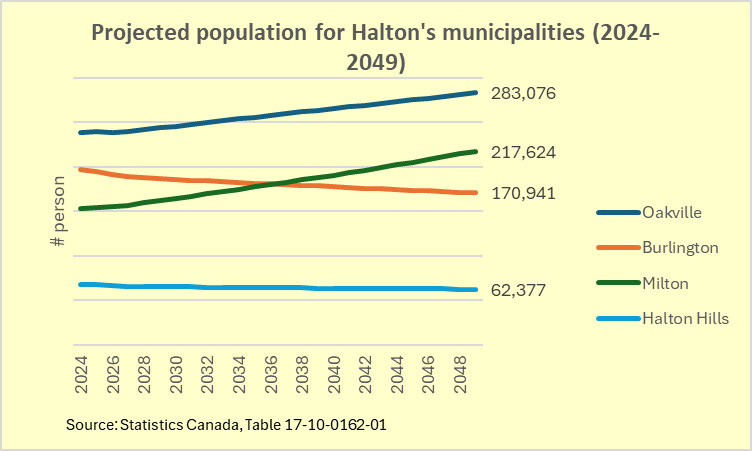
Figure 1 (Above): Projected Population for Halton's Municipalities, 2024-2049
Source: Statistics Canada, Population Projections for Census Divisions and Subdivisions
Milton: The Fastest-Growing Municipality
Milton is clearly the growth engine of Halton over the projection period.
· Population grows from 152, 817 in 2024 to 217,624 in 2049
· This represents an increase of nearly 65,000 people (about +42%)
· Growth is steady and persistent across the entire period, with no slowdown visible
Oakville: Steady Growth from a Large Base
Population shows consistent but moderate growth, starting from the largest population base in Halton.
· Population increases from 238,716 in 2024 to 283,076 in 2049
· This is a gain of about 44,000 people (roughly +18%)
· Growth is smooth and linear, without sharp acceleration or reversals
Burlington: Gradual and Sustained Population Decline
Burlington is the only municipality in Halton projected to experience long-term population decline.
· Population falls from 197,351 in 2024 to 170,942 in 2049
· This is decrease of about 26,400 people (roughly -13%)
· The decline is gradual but persistent across the entire period.
Halton Hills: Smallest and Slowing Decline
Halton Hills remains the smallest municipality in Halton and experiences a slow, steady population decline.
· Population decreases from 68,042 in 2024 to 62,377 in 2049
· This represents a loss of about 5,700 people (roughly -8%)
· The downward trend is consistent but modest
The Big Picture for Halton: Growth and Aging Happen Together
While Halton’s population is projected grow through 2029, the age structure of the population will shift significantly over the same period. In 2024, children aged 0-14 make up about 17% of Halton’s population, working-age adults (15-64) account for roughly 67%, and seniors aged 65 and over represent 16%. By 2049, these proportions change markedly. The share of children is projected to decline to about 14%, while the working-age population drops to just under 59%. In contrast, the senior population expands substantially, rising to more than 27% of all residents. In practical terms, this means that more than one in four Halton residents will be 65 or older by 2049, compared to about one in six today.
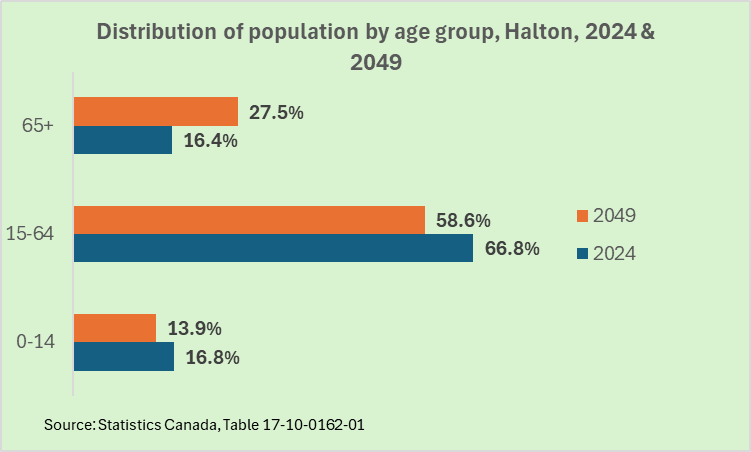
Figure 2 (Above): Distribution of population by age group (Source: Statistics Canada, Population Projections for Census Divisions and Subdivisions)
This projected aging of the population reflects broader demographic forces including longer life expectancy and the aging of larger cohorts and underscores that population growth alone does not tell the full story. Even in municipalities experiencing overall growth, the balance between children, worker, and seniors is shifting, and community implications for housing, health care, transportation, labour supply, and community supports. Planning for Halton’s future will therefore require not only accommodating more residents but also adapting to a much older population profile than the region has today.
[1] Statistics Canada, Population Projections for Census Divisions and Subdivisions, 2024 to 2049: Technical Report, November 28, 2025, https://www150.statcan.gc.ca/n1/pub/17-20-0003/172000032025001-eng.htm
[2] Statistics Canada, Projected population for census divisions and census subdivisions, 2021 boundaries, by projection scenario, age and gender, as of July 1, https://www150.statcan.gc.ca/t1/tbl1/en/tv.action?pid=1710016201
[3] Ibid



I highly recommend their fertility consultants clinic in London to anyone searching for experienced fertility professionals. The consultant was incredibly knowledgeable and created a treatment plan based on my individual needs rather than following a standard approach. The clinic staff were welcoming, friendly, and always available to answer my questions, making every visit a positive experience. http://www.lunafertility.co.uk